





2000W Modified Sine Wave Inverter: Buyer’s Complete Guide
- Choosing the right inverter for your needs
- Understanding what 2000 watt modified sine wave inverter means
- Typical use cases and why people pick modified sine
- Which voltage systems pair well with a 2000W inverter?
- Performance, compatibility and technical limits
- Continuous vs surge power and what to expect
- Load compatibility — what works and what doesn't
- Harmonic distortion and equipment stress
- Sizing batteries, wiring, and installation best practices
- Estimating battery capacity for a 2000W inverter
- Cable sizing and fuse selection
- Ventilation, placement, and safety
- Comparisons, data and when to choose modified sine vs pure sine
- Side-by-side technical comparison
- When a modified sine is the pragmatic choice
- When to upgrade to pure sine
- Practical buying checklist and recommended specifications
- Checklist before you buy
- Sample specification table (typical model)
- Standards and certifications to look for
- Installation examples, troubleshooting and maintenance
- Common installation scenarios
- Troubleshooting frequent issues
- Maintenance tips
- Manufacturer insight — Guangzhou Congsin Electronic Technology Co., Ltd.
- FAQs
- 1. Can I run a refrigerator on a 2000W modified sine wave inverter?
- 2. How long will a 2000W inverter run on a 100Ah 12V battery?
- 3. Are modified sine inverters dangerous for laptops or phone chargers?
- 4. What wiring gauge do I need for a 2000W inverter on 12V?
- 5. How do I know if my inverter has enough surge capacity?
- 6. Can I parallel multiple 2000W modified sine inverters for more power?
I write this guide to help you quickly decide whether a 2000 watt modified sine wave inverter is the right choice for your application. I cover real-world performance, typical limitations, how to size batteries and circuits, installation and safety tips, and a comparison with pure sine wave inverters so you can make a purchase that meets your needs and budget.
Choosing the right inverter for your needs
Understanding what 2000 watt modified sine wave inverter means
When I say 2000 watt modified sine wave inverter, I refer to an inverter rated to deliver approximately 2000 watts of continuous AC output from a DC source (usually 12V, 24V, or 48V battery banks), and that produces a stepped or approximated sine waveform rather than a clean, continuous sine wave. Continuous power (2000W) is the amount you can run as a steady load; many units provide a higher short-duration surge rating to start motors or compressors.
Typical use cases and why people pick modified sine
Customers often choose modified sine inverters for budget-conscious builds where cost per watt matters. Common uses I see include powering LED lights, laptop chargers, phone chargers, basic power tools, small TVs, and simple appliances in RVs, vans, boats, and backup power setups. For resistive loads (incandescent heaters, many bulbs) a modified sine works acceptably. For some motor-driven or sensitive electronics it can be problematic — I'll cover compatibility below.
Which voltage systems pair well with a 2000W inverter?
2000W inverters are typically offered for 12V, 24V and 48V DC systems. In a 12V system a 2000W inverter draws high currents (~2000W / 12V = ~167A, ignoring losses) so thicker cables and robust battery banks are required. I usually recommend 24V or 48V for continuous 2000W usage to reduce conductor size and improve efficiency, especially for long-term or mobile installations.
Performance, compatibility and technical limits
Continuous vs surge power and what to expect
Most 2000W modified sine inverters advertise a surge rating of 2x–3x continuous for a few seconds (commonly 4000W surge). Surge capacity matters for starting inductive loads like refrigerators and power tools. However, surge ratings vary by model and depend on battery capacity and inverter cooling. Always check the datasheet for exact surge duration and conditions.
Load compatibility — what works and what doesn't
Modified sine output is adequate for many everyday devices: phone and laptop chargers, incandescent bulbs, many LED lights, simple power tools, and some small kitchen appliances. Devices that often have problems include:
- Appliances with electronic motor controls (variable-speed compressors, some microwave ovens).
- Medical equipment and precision lab instruments.
- Audio equipment and some TVs that can produce hum/whine.
- Induction cooktops and laser printers.
For a technical reference on inverter basics and waveforms see the Inverter (electrical) page on Wikipedia: https://en.wikipedia.org/wiki/Inverter_(electrical).
Harmonic distortion and equipment stress
Modified sine produces higher total harmonic distortion (THD) than pure sine wave inverters. Higher THD can increase heating in motors and transformers and may reduce the life or cause malfunctions in sensitive electronics. When running motors, I advise checking motor current draw and allowable waveforms in the motor or appliance manual.
Sizing batteries, wiring, and installation best practices
Estimating battery capacity for a 2000W inverter
To size battery capacity: calculate daily energy consumption (Wh) = device power (W) × hours used. Account for inverter efficiency (modified sine inverters typically 85%–92% under mid-load). For example, running 2000W continuous for one hour requires about 2000Wh; with 90% inverter efficiency it needs ≈2220Wh from the battery. For a 12V system that equals ≈185Ah (2220Wh/12V ≈ 185Ah). Because deep discharging batteries shortens life, I usually recommend planning for 50% depth-of-discharge for lead-acid batteries (less for longevity), or using appropriately sized lithium batteries.
See battery fundamentals and storage guidelines at Battery University: https://batteryuniversity.com/article/bu-808-battery-storage-systems.
Cable sizing and fuse selection
High currents require heavy gauge cables and properly rated fuses. For a 12V → 2000W setup, continuous current can exceed 160A; you should use properly rated cable (often 1/0 AWG or larger depending on run length) and a fuse/breaker sized for the inverter's continuous current plus a margin. For 24V or 48V systems the current halves or quarters respectively, allowing smaller wiring. I always follow standards and inverter manufacturer wiring diagrams to avoid voltage drop and heat.
Ventilation, placement, and safety
Install the inverter in a dry, ventilated space away from battery gases and flammable materials. Ensure the inverter's fans and vents have clearance for airflow. Grounding the AC output and following local electrical codes is essential. For built-in or vehicle installations, consider remote on/off switches and a master battery disconnect for safety.
Comparisons, data and when to choose modified sine vs pure sine
Side-by-side technical comparison
Below I summarize the practical differences most buyers care about. The numbers for THD and efficiency are typical ranges; always check the specific model's datasheet.
| Characteristic | 2000W Modified Sine Wave Inverter | 2000W Pure Sine Wave Inverter |
|---|---|---|
| Output waveform | Stepped/approximated sine | Clean sinusoidal waveform |
| Typical THD | 10%–30% (varies) | <5% (often <3%) |
| Typical efficiency | 85%–92% | 90%–96% |
| Compatibility | Resistive loads, simple electronics, many tools | Sensitive electronics, motors with variable controls, medical devices |
| Typical price | Lower | Higher |
| Recommended when | Budget constraints, non-sensitive loads | Audio/video, refrigeration, medical, or precision equipment |
When a modified sine is the pragmatic choice
I recommend a 2000 watt modified sine wave inverter when you need cost-effective power for non-sensitive devices, or when the budget doesn't permit a pure sine solution. For portable power stations, emergency lighting, construction tools, and basic RV loads, a modified sine inverter often gives acceptable performance at a lower price.
When to upgrade to pure sine
Upgrade to pure sine if you plan to power variable-speed compressors, medical equipment, sensitive electronics (audio/video editing setups), or if manufacturers explicitly require a sine output. Pure sine saves troubleshooting time and reduces the risk of device damage or noise issues.
Practical buying checklist and recommended specifications
Checklist before you buy
Before buying a 2000 watt modified sine wave inverter, I always run through this checklist:
- Confirm continuous and surge ratings match your peak starting loads.
- Verify the inverter input voltage matches your battery bank (12V/24V/48V).
- Check datasheet for THD and efficiency numbers.
- Ensure adequate battery capacity and cabling are in your plan.
- Look for safety approvals (CE, ETL, FCC, RoHS, etc.).
- Confirm cooling and recommended installation clearances.
- Review warranty, support, and available certifications.
Sample specification table (typical model)
| Spec | Example Value | Notes |
|---|---|---|
| Continuous power | 2000W | Rated at 25°C, per datasheet |
| Surge power | 4000W (10s) | Short-duration motor start |
| Input voltage | 12V / 24V / 48V options | Choose to match battery bank |
| Output waveform | Modified sine | Check THD for sensitive loads |
| Efficiency | ~90% | Depends on load level |
| Protections | OVP, UVP, OCP, short-circuit, thermal | Required for safe use |
Standards and certifications to look for
Certifications such as CE, EMC, LVD, ETL, FCC, RoHS and automotive E-MARK indicate the product was manufactured to recognized safety and emissions standards. For general inverter concept references, see the IEEE and inverter technical resources and the inverter article on Wikipedia: https://en.wikipedia.org/wiki/Inverter_(electrical).
Installation examples, troubleshooting and maintenance
Common installation scenarios
Typical installations include: vehicle/RV power centers, off-grid cabins with solar charge controllers and battery banks, portable jobsite power, and emergency backup at homes for essential circuits. In solar installations, pair the inverter with a solar charge controller and battery bank sized to the expected load and charging input.
Troubleshooting frequent issues
If you see nuisance shutdowns: check battery voltage under load (low battery will cause undervoltage trip), inspect wiring for voltage drop, and ensure the inverter cooling fan is operational. If sensitive devices exhibit noise or run poorly, test the same load on a pure sine inverter or grid power to isolate waveform compatibility.
Maintenance tips
Keep vents clear, check DC connections periodically for tightness and corrosion, and monitor battery health. Replace batteries based on manufacturer recommendations and state-of-health metrics. Record run-times and loads during commissioning to validate your expected performance.
Manufacturer insight — Guangzhou Congsin Electronic Technology Co., Ltd.
Guangzhou Congsin Electronic Technology Co., Ltd., founded in early 1998, is a professional power inverter manufacturer with over 27 years of focused experience. We design, R&D and manufacture a wide range of power solutions—with a core emphasis on DC→AC power inverters, portable power stations, and solar charge controllers. Our catalog includes 100+ models tailored for vehicles, solar systems, RVs and trucks, off-grid homes, outdoor offices, patrol and field construction work.
We operate fully automated production lines, advanced instrumentation and multifunctional testing equipment to ensure product reliability, efficiency and intelligent functionality. Environmental and safety compliance are built in: our quality system is ISO9001 certified and many products hold international approvals such as CE, EMC, LVD, ETL, FCC, RoHS and E-MARK. Several independently developed patents further demonstrate our commitment to innovation.
Congsin’s products serve global markets across Europe, the Americas, the Middle East, Africa and Southeast Asia; many models are supplied to domestic and international OEM channels. Our support includes OEM/ODM, private labeling, distribution and bespoke customization to meet partner specifications.
Our mission is to deliver reliable, efficient and affordable energy solutions that enable energy independence.
Summary of Congsin advantages and main products: Congsin specializes in Solar Charge Controllers, modified sine wave inverters, pure sine wave inverters, and portable power stations. Their strengths include long industry experience, robust automated manufacturing, multiple international certifications, an extensive model range (100+), OEM/ODM capability, and a global distribution footprint. These factors make Congsin a competitive supplier for projects that need certified, customizable DC→AC solutions.
FAQs
1. Can I run a refrigerator on a 2000W modified sine wave inverter?
Possibly — many refrigerators have a compressor start surge that a 2000W inverter with sufficient surge capacity can handle. However, modern refrigerators with electronic controls or variable-speed compressors may be sensitive to modified sine wave output. Check the appliance manufacturer’s guidance; when in doubt use a pure sine inverter.
2. How long will a 2000W inverter run on a 100Ah 12V battery?
A fully charged 100Ah 12V battery has about 1200Wh (12V × 100Ah). Accounting for inverter efficiency (~90%), usable power is about 1080Wh. Running 2000W continuously is not feasible; the inverter will draw high current and the battery will deplete very quickly (less than an hour) and could trip undervoltage protections. For continuous 2000W use you need a much larger battery bank or higher battery voltage.
3. Are modified sine inverters dangerous for laptops or phone chargers?
Most phone and laptop chargers are switching power supplies and tolerate modified sine wave output. I still recommend testing critical electronics or using a pure sine inverter for peace of mind.
4. What wiring gauge do I need for a 2000W inverter on 12V?
Expect continuous currents around 160–180A at 12V for 2000W loads. Typical installations use 1/0 AWG or larger for short runs; the exact gauge depends on cable length and acceptable voltage drop — consult standards and the inverter manual.
5. How do I know if my inverter has enough surge capacity?
Compare the appliance starting current to the inverter's surge rating and duration in the datasheet. If your appliance needs a 3000W start for 2 seconds and the inverter can deliver 4000W surge for 10 seconds, it should start. However, frequent use near surge limits stresses the inverter and battery; design for margin.
6. Can I parallel multiple 2000W modified sine inverters for more power?
Some inverters support parallel operation; many modified sine models do not. For parallel operation you need inverters with synchronization ability and proper load-sharing controls. Check the manufacturer's specifications and consider using a single higher-power inverter or a pure sine solution if you need reliable parallel operation.
If you need help selecting a model, sizing batteries, or evaluating compatibility with specific appliances, contact our team for a tailored recommendation. To explore Congsin's 2000W and other inverter models, OEM/ODM options, or request technical datasheets and certifications, please get in touch.
Contact & Product Inquiry: Reach out to Guangzhou Congsin Electronic Technology Co., Ltd. for product catalogs, customization, and pricing. Our specialists can advise on inverter selection (modified sine and pure sine), solar charge controllers, and portable power stations to match your project requirements.
How High Frequency Inverters Improve Power Density and Efficiency
What are the application scenarios of modified sine wave inverter?
Top 10 oem portable energy storage power supply Manufacturers and Supplier Brands
Safety and Compliance: Standards for UPS Power Inverters
Modified Sine Wave Inverters
Can this inverter power a laptop?
If the laptop power is within 150W and the input is AC220V, it can supply power normally.
How to connect to the battery?
Use the included battery clips, connect the red clip to the positive pole of the battery and the black clip to the negative pole. Ensure good contact and no short-circuit risk when connecting.
Can 4 USB ports charge 4 mobile phones at the same time?
Yes, the total current of 6.8A can support simultaneous fast charging of multiple devices, and the charging efficiency is guaranteed.
Pure Sine Wave Inverters
What is the reason for the inverter automatically shutting down during operation?
It is likely that the protection mechanism is triggered: 1. Load overload (total power of connected devices exceeds 1000W); 2. Abnormal input voltage (battery voltage <10.8V or >14.5V); 3. Device overtemperature (excessively high ambient temperature or cooling fan failure). It is recommended to disconnect some loads, check the battery voltage or clean the heat dissipation port before trying again.
Will reversing the positive and negative poles damage the device when connecting the battery?
The device has a built-in reverse connection protection function, which will automatically cut off the circuit when the positive and negative poles are reversed to avoid damage caused by reverse current inflow; just adjust the connection order of the positive and negative poles of the battery clip and re-power on to use normally.
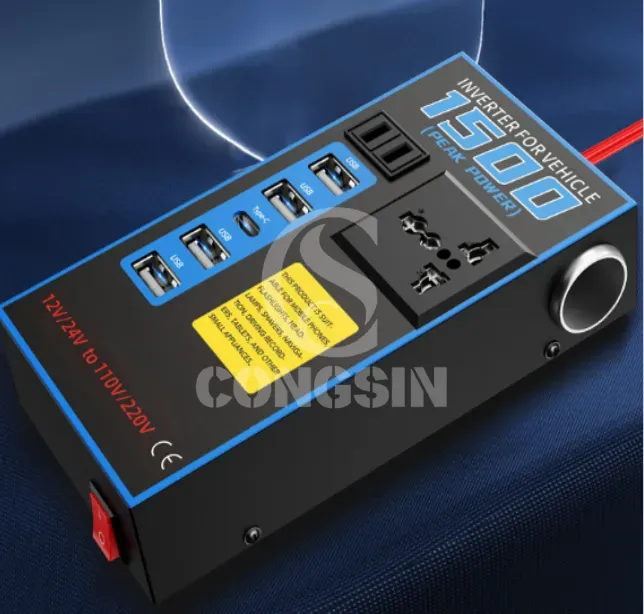
Congsin 1500W Inverter for Vehicle DC 12V/24V to AC 110V/220V with Universal socket Modified Sine Wave
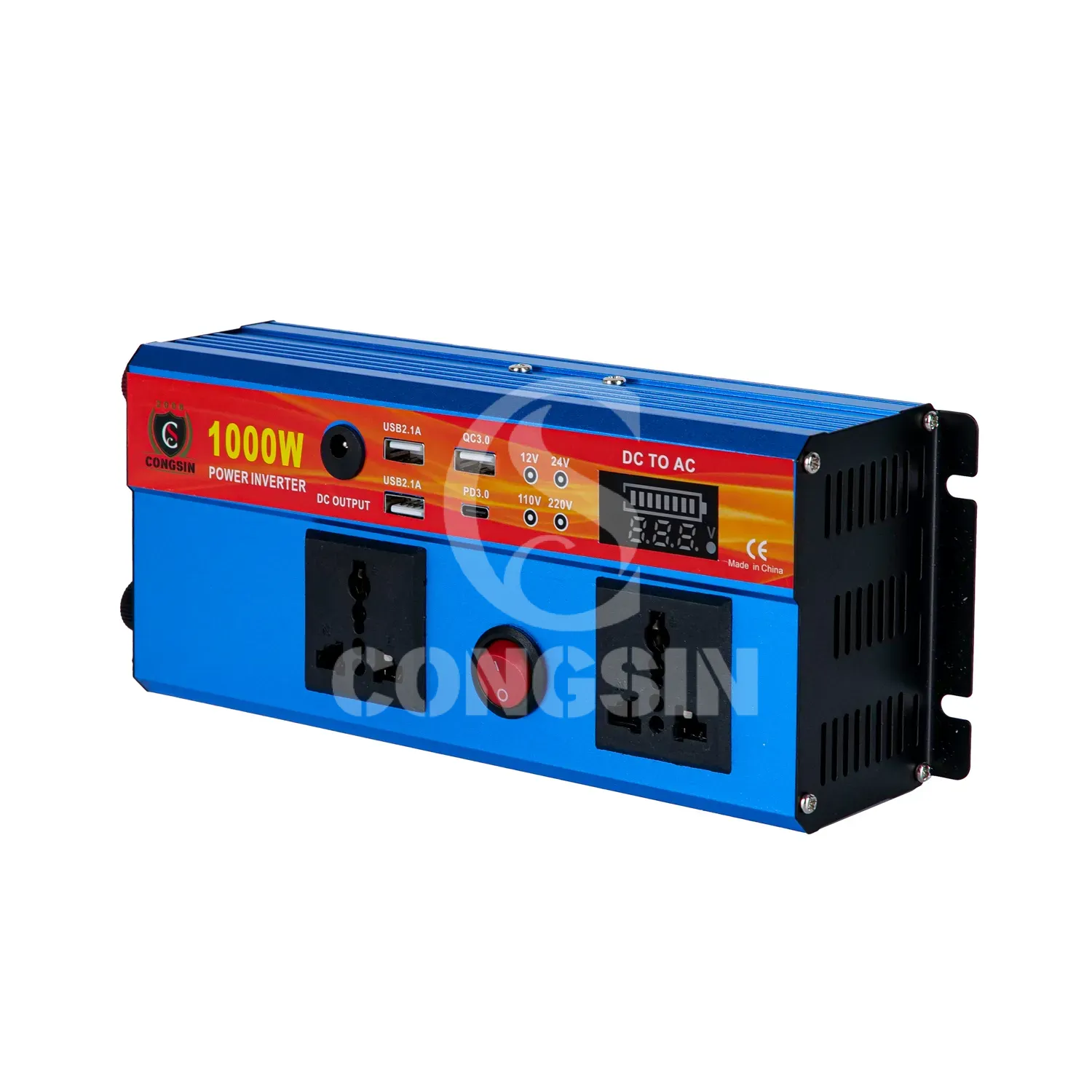
Congsin 1000W modified sine wave inverter with LED display and Type C port car RV power inverter
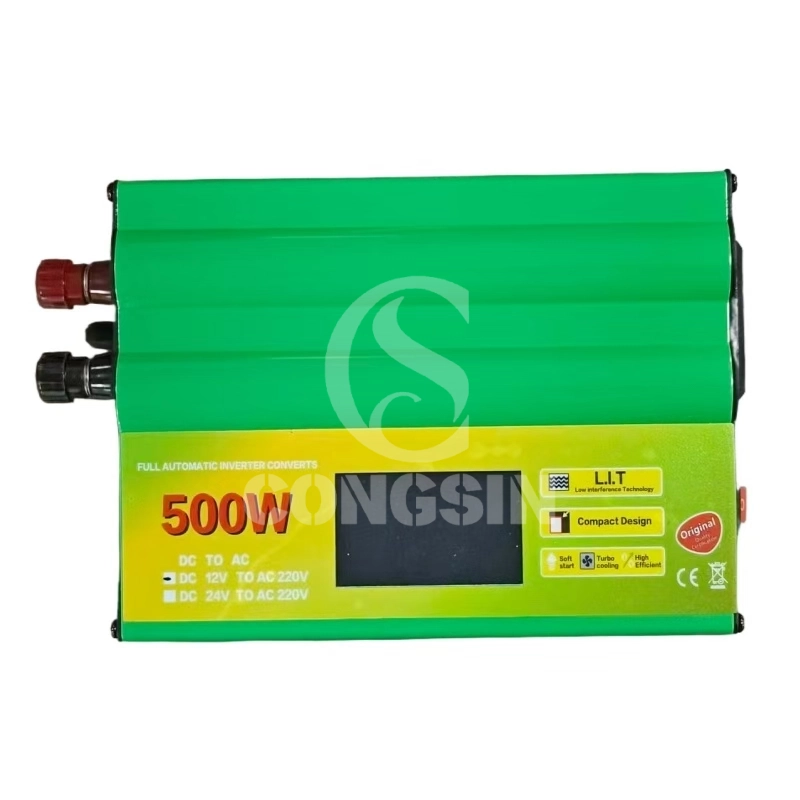
Congsin Modified Sine Wave Inverter 500W 1000W 1500W 12V LED Display Portable for RV Car Solar
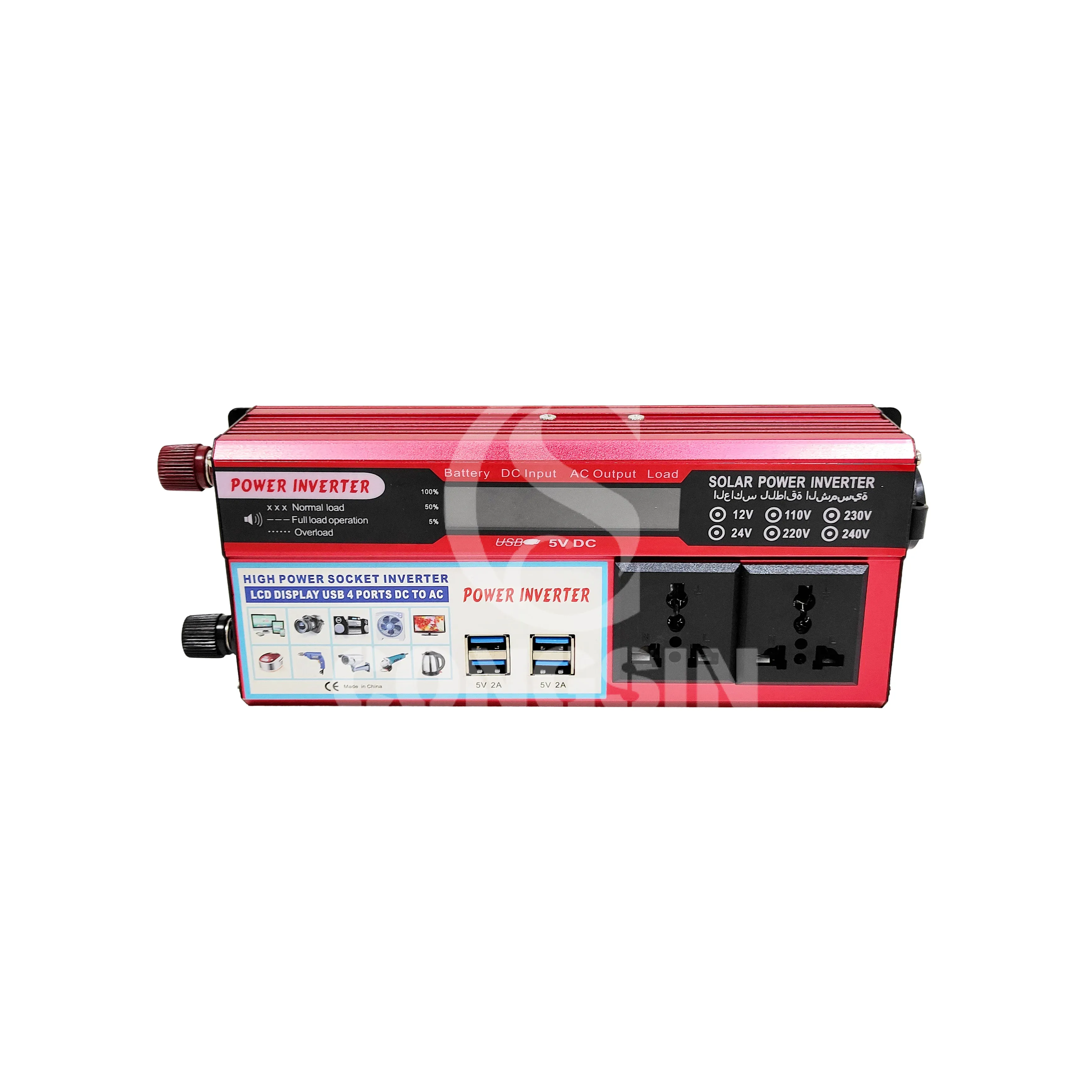
Congsin 1500W modified sine wave inverter with LCD display and USB ports for RV car boat home use

CONGSIN is a trusted OEM factory for power inverters, solar charge controllers, and DC converters. Reliable solutions for global B2B buyers.
 High Quality
 7/24 Service
 Guaranteed Warranty
© 2025 Congsin. All Rights Reserved.